
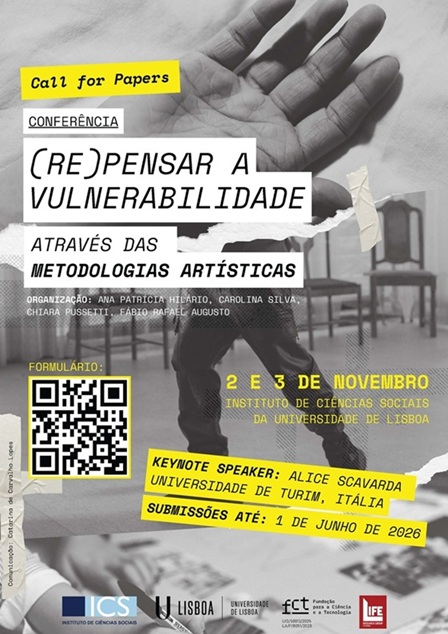
2 e 3 de novembro, no ICS-ULisboa
Submissão de propostas até 1 de junho de 2026
Toda a informação Aqui!
Within the fields of Social Sciences, arts-based research methods have increasingly emerged as particularly generative approaches when working with socially vulnerable populations or when addressing sensitive topics in which embodied experience, affect, sensory perception, and memory are central to the research process. Practices such as filmmaking, drama, music, poetry, dance, photography, and drawing, once primarily associated with artistic production, are now widely adopted as sociological, anthropological, and psychological research tools, both for participatory and collaborative forms of data generation and interpretation, as well as for the dissemination of research findings.
In this context, arts-based methodologies are understood and mobilised as a form of epistemic care, which recognises knowledge as relational, situated, and co-produced rather than detached or extractive. Arts-based methods can help address the power imbalances that often exist between researchers and participants by encouraging more horizontal and dialogical relationships, grounded in reflexivity, attentiveness, and mutual responsiveness. They also enable the acknowledgement and valuing of experiences of fragility, vulnerability, and marginalisation, reinforcing a collective responsibility to create spaces of recognition, voice, and dignity, especially in contexts where affective, sensory, and embodied registers carry forms of knowledge that resist purely discursive articulation.
Building on these considerations, the conference seeks to critically engage with the ethical, methodological, and political implications of arts-based methods by addressing the following questions:
● What challenges and opportunities arise when using arts-based methods within sociological and anthropological research, particularly with vulnerable or marginalised groups and/or when addressing sensitive topics?
● How do these methods shape ethical relations, power dynamics, and responsibilities between researchers, participants, and communities?
● In what ways do arts-based approaches contribute to recognising, representing, and valuing experiences of fragility and social inequality?
● What roles do artists play in the design, development, and implementation of ethically grounded and relational research practices? And in what ways does “making with” others open more visceral, affective, and intimate forms of understanding and knowledge that exceed the limits of verbal communication?
We warmly invite contributions that engage with these and related questions and offer empirical, methodological, theoretical, or practice-based reflections. Submissions are welcomed from researchers, doctoral candidates, artists, practitioners, and interdisciplinary scholars working within sociology, anthropology, and related fields.
Participation is free of charge. Presentations may be delivered in English or Portuguese. Multimodal presentations are encouraged, including video, performance, or other forms, to be delivered within a 20-minute time frame.
Abstracts (up to 200 words), accompanied by a short biographical note (100 words), should be submitted via the online form by 1 June 2026. Contributors proposing multimodal formats are kindly asked to indicate any technical requirements in the form. Notifications of acceptance will be sent by 15 July 2026. For any questions regarding the submission process, please contact: lifeconference2026@gmail.com.
The conference will take place on November 2–3 at ICS-ULisboa, featuring a keynote lecture by Alice Scavarda (University of Turin, Italy).